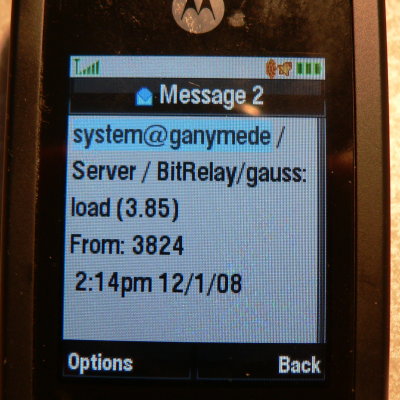
Woo hoo, here’s a fun e-mail from another satisfied customer.

Sometimes funny, sometimes thoughtful, always a good time
Woo hoo, here’s a fun e-mail from another satisfied customer.

Whee, sign me up for a $17,000 bill to help the rich guys on Wall Street and the morons who picked up mortgages they couldn’t afford.

So Digg just raised $28 million in venture capital.
I’m not really sure what the heck they’re going to do with that… I mean, Digg is basically a web site with a database and a comment system where tens of thousands of people go to discuss interesting news items. The hosting and bandwidth bills are probably pretty steep, and of course you’d need a staff (half a dozen?) of server administrators, but beyond that it’s kind of nebulous what $28 million would do.
I guess I’ve been running on a shoestring budget far too long. I’m going to see if I can raise a few mil in venture capital to keep boomflag.com running.
Tom and I spent four days backpacking in the Wind River Range, part of the Teton mountains in northwest Wyoming. What a spectacular trip.


We had some interesting adventures involving blowing out a tire and almost getting stuck fifty miles from civilization in the sagebrush, pouring rain and lightning above treeline, and of course a night in the tent while the rain lashed at the fly and thunder boomed overhead. And by our calculations we hiked around 27 miles, both carrying 50-pound packs up steep grades and across boulder fields where the rocks were the size of cars.
A good time all around.
The Department of Homeland inSecurity has unveiled its shiny new terrorist screening system, which will scan people walking through the airport and identify those who appear to be suspicious. That’s right: it will analyze pulse rate, breathing, skin temperature, and even “fleeting facial gestures”. People who are flagged as suspicious will be pulled aside for “enhanced screening”. Hoo boy.
DHS is bragging about this system because in tests with 140 people, some of whom were told to “act suspicious”, it correctly identified 78% of them. 78%! And they act like it’s some kind of triumph that people who were intentionally acting suspicious were flagged as such. A trained police officer– or possibly even an untrained clown from the street– could probably have identified every one of them.
Leaving aside the horrendous implications of a system designed to basically analyze our thoughts and intents, the mind reels to consider how colossally ineffective this system will actually be. I think Cory Doctorow’s analysis of such a system (written prior to this announcement) sums it up quite nicely.
Say you have a new disease, called Super-AIDS. Only one in a million people gets Super-AIDS. You develop a test for Super-AIDS that’s 99 percent accurate. I mean, 99 percent of the time, it gives the correct result: true if the subject is infected, and false if the subject is healthy. You give the test to a million people.
One in a million people have Super-AIDS. One in a hundred people that you test will generate a “false positive”– the test will say he has Super-AIDS even though he doesn’t. That’s what “99 percent accurate” means: one percent wrong.
What’s one percent of one million?
1,000,000/100 = 10,000
One in a million people has Super-AIDS. If you test a million random people, you’ll probably only find one case of real Super-AIDS. But your test won’t identify one person as having Super-AIDS. It will identify 10,000 people as having it.
Your 99 percent accurate test will perform with 99.99 percent inaccuracy.
That’s the paradox of the false positive. When you try to find something really rare, your test’s accuracy has to match the rarity of the thing you’re looking for. If you’re trying to point at a single pixel on your screen, a sharp pencil is a good pointer: the pencil-tip is a lot smaller (more accurate) than the pixels. But a pencil-tip is no good at pointing at a single atom in your screen. For that, you need a pointer– a test– that’s one atom wide or less at the tip.
This is the paradox of the false positive, and here’s how it applies to terrorism:
Terrorists are really rare. In a city of twenty million like New York, there might be one or two terrorists. Maybe ten of them at the outside. 10/20,000,000 = 0.00005 percent. One twenty-thousandth of a percent.
That’s pretty rare all right. Now, say you’ve got some software that can sift through all the bank-records, or toll-pass records, or public transit records, or phone-call records in the city and catch terrorists 99 percent of the time.
In a pool of twenty million people, a 99 percent accurate test will identify two hundred thousand people as being terrorists. But only ten of them are terrorists. To catch ten bad guys, you have to haul in and investigate two hundred thousand innocent people.
Guess what? Terrorism tests aren’t anywhere close to 99 percent accurate. More like 60 percent accurate. Even 40 percent accurate, sometimes.
What this all means is that the Department of Homeland Security has set itself up to fail badly. They are trying to spot incredibly rare events– a person is a terrorist– with inaccurate systems.
I can hardly wait to go to the airport this Friday to fly to St. Louis.
Sunny.
No clouds.
No wind.
77 degrees.
An awesome time for ultimate. Game on.
Charles Gibson interviewed Sarah Palin on Good Morning America and her answers to some of his questions were astounding.
For example, take this exchange:
GIBSON: What insight does that give you into what they’re doing inside Georgia?
PALIN: Well, I’m giving you that perspective of how small our world is and how important it is that we work with our allies to keep good relations with all of these countries, especially Russia.
Wow. Does she even know where Georgia is? Does she have any idea what’s been going on there for the past month? Her answer had absolutely zero content.
I’m not a foreign affairs expert, but even reading the occasional Yahoo News story gives me enough information to have an intelligent conversation about the situation. It sounds like our possible future vice president figures that since she can see the coastline from some point in her home state, she’ll be able to handle all of those silly men with their tanks and planes.
People are dumb.
Hurricane Ike has been cruising toward the Texas coast for several days, and emergency planners issued mandatory evacuation orders for everyone living on Galveston Island, the low-lying area where Ike would hit first with full force. They used terms like “certain death” for those who refused to leave.
But, of course, people ignored them. Estimates currently say that upward of 100,000 people might still be in that area, and it’s likely many of them are dead. I’m all for free will and choosing for thyself, but sometimes you just have to see that your defiance of a hurricane the size of Texas isn’t really going to change the reality that it’s going to flatten your house and wash you away in a thirteen-foot wall of water.
Here’s a classic quote from a guy named Steven Rushing, who lives on Galveston Island:
I guess that’s the last time your family listens to your promises, Steven.
Worse than those who choose to foolishly “brave” the storm are those who stay and then, at the last minute, decide it’s not going to turn out so well and try to leave. They call– nay, demand– help from emergency personnel, and then we have noble police and firefighters who risk their own lives to save the dolts who refused to leave while the leaving was good.
I’m sympathetic to those who were hurt or killed in the storm, and clearly it’s a huge tragedy on many levels. But it’s hard for me to conjure up sympathy for the idiots who refuse to listen to the experts who are telling them it’s going to be a big deal.
I managed to get a Super Nintendo emulator running on my hacked Xbox, which means I can play all of those cheesy arcade games I played at Dirk’s house when I was fourteen or whatever. I still remember when Tetris was the newest craze, when Super Mario World seemed unbeatable, and when Zelda’s quest was the coolest thing. I even remember Super Bomberman and Starfox from– I’m a little ashamed to admit– my college days.
But my favorite was Gradius, and now I’ve got it on my bigscreen in all its glory. Too bad I can’t beat the first level– clearly my skills have become rusty over the past twenty years.
Ahh, good times. Now my kids can see these games and tell me how much the graphics suck compared to today’s games.
Every Friday evening we have Pizza and Movie Night, where we make homemade pizza and watch a movie that’s appropriate for the fam. Tonight we thoroughly enjoyed the Rifftrax version of Harry Potter and the Sorceror’s Stone. Rifftrax is the brainchild of Mike Nelson, famous for creating the 90’s TV show “Mystery Science Theater 3000”. Basically it’s an audio track that you play while you watch a movie on DVD, and it’s Mike and a couple of his buddies cracking jokes throughout the movie.
What an absolute riot. I don’t think I’ve laughed so hard in a long time. Tears were rolling down my cheeks, and the kids were howling. Next time I think we’re going to take a look at the Rifftrax treatment of Lord of the Rings, which should be a real hoot as we laugh at The Dark Lord Sauron.