05/03/2006

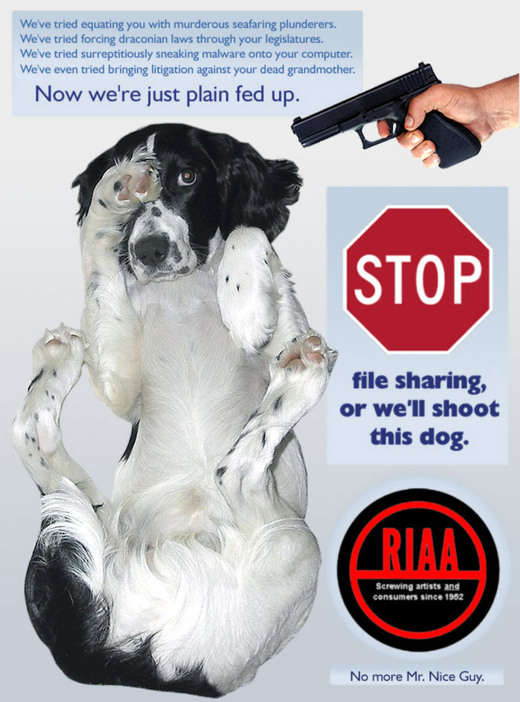
As the RIAA and MPAA continue their sad and misguided quests to control the distribution and use of all audio and video media, I’ve been thinking about the boundaries of copyright law and how, precisely, they fit into the business model these groups are attempting to force on consumers.

I came up with a little gedankenexperiment to illustrate my thought process, and I’m curious where the lines are drawn. Here goes.

Laralee and I have heard good things about the TV series Alias, so we decided to watch a few episodes. I went to Blockbuster and rented the first episodes of season one. This is a set of two DVDs with a total of eight 45-minute episodes. It’s important to note that Blockbuster requests that the DVDs be returned in one week.

Okay, so I take home the DVDs and we pop them into the DVD player to watch the pilot episode. I don’t think anyone would argue that we’re breaking any copyright laws.

But now, as part of our thought experiment, let’s pretend my DVD player broke after we watched the pilot. We’ve still got seven episodes to watch, and a few days before we have to return them to Blockbuster. What to do? No problem– I’ve got a computer with a DVD drive. We head over to the computer and insert the DVD, then sit back to watch episode 2. Still no copyright infringement, right?

Dang, the DVD drive is pretty sluggish and the computer is having trouble playing the show at full speed. We’re getting lots of choppy scenes and pauses, and it’s really annoying. The show isn’t watchable, so I tell Laralee it’s no problem– I’ll just copy it to the computer’s hard drive, which is much faster than the DVD drive.

It takes a while, but eventually we have the files on the hard drive. We crank up the DVD software and tell it to load the hard drive “disc image” instead of a physical disc. It’s much faster than before, and we enjoy episode 3.

But we’re pretty busy in the evenings, and we don’t get a chance to watch for a few nights. Blockbuster wants the DVDs back or they’ll charge us. What to do? Well, how about if I copy the second DVD to my hard drive as well? Then I can return them to Blockbuster, and we’ll just watch the next episodes at our leisure. So I do that, return the DVDs, and we watch episode 4 that night.

Keep in mind that recording something to watch later is called “time shifting” in the industry, and that’s all I’ve done here– I’ve taken a legal copy of a DVD I rented and time-shifted the content a couple of days, so we can watch it when we find the time to do so. The federal courts have upheld the right to time-shift video content as “fair use” under copyright law, so it seems I still haven’t broken any laws.

Fortunately, I manage to fix my DVD player. Obviously I’d rather watch the bigscreen from the couch than the teensy computer monitor in an office chair. But how? Wait– I’ve got a couple of DVD-R discs in my office (I use them for periodic data backups). I grab them and burn the hard drive image to a DVD. Now Laralee and I can watch episode 5 on the bigscreen.

Are we there yet? Have we broken the law?

Now my friend wants to come over and watch the show with us. He’s heard it’s a good series, so we invite him to the house and we all watch episode 6. Does this count as a “public performance”, which is the term we see in all those FBI warnings at the start of all DVDs? We’re still in the privacy of our home, and we didn’t charge admission or anything, so we’re probably okay.

My friend really likes the show, and wants to see episode 7, but sadly he can’t come over tomorrow, so I lend him the DVD. He takes it home and watches it on his own television, then returns it to us a few days later. Is this legal?

Finally, my friend says he wants to see episode 8 as well, but he’s moving out of the state. Because I’d hate for him to miss the pivotal episode, I burn a second DVD-R and mail it to him so he can watch it in his new house.

You can see how there’s a natural progression here; my question is where it crosses the line into criminal activity. The MPAA would have us believe that “pirating” movies hurts the artists– and far be it from me to hurt Jennifer Garner, the star of Alias— but what actions here were hurtful to her or to the industry in general?

It’s hard to know what’s legal and what’s not with the changing landscape of digital technology, and my gedankenexperiment really isn’t that far removed from reality. What does the MPAA want? Is it realistic for them to expect me to buy a new DVD player and television (with appropriate digital rights management software on both) so I can watch season 2 of Alias? Current proposed legislation would have us do exactly that. Is it unreasonable for me to watch it on a computer, or time-shift it to a more convenient day?

These are tough questions, but I think the approach of the MPAA and RIAA is completely out of touch with reality, and will only serve to alienate the very people who are purchasing their products. It’s a short-sighted solution to a dead business model, and sooner or later it will catch them.

04/29/2006

Today I was lucky enough to play my first-ever game of Dance Dance Revolution– the dancing craze that’s been sweeping the nation for about two years. Watched by legions of adoring fans in the form of our friends the Francii, as well as a spellbound Laralee, I succeeded in providing untold entertainment.

There are more photos than these, but I think they truly capture the spirit of my performance. Notice my friend Jessica laughing her teenage head off in the last shot.

My shirt, incidentally, is the Yoda shirt with the phrase “Do or do not, there is no try.” I think it’s safe to say that when it comes to dancing, my answer is a solid “do not”.

04/27/2006

Congress continues to be on the forefront of trampling our rights, as another bill was introduced in the Senate that would make it illegal to broadcast streaming MP3 music over the internet. Only Windows Media or Real files (both crappy formats) would be allowed because they support encryption and licensing.

Never mind that internet radio stations who are currently streaming MP3’s are doing so in a completely legal fashion (the RIAA has seen to it that the “pirate” stations have all been shut down). They pay royalties to the appropriate copyright holders before sending the music over the wire. But since it’s possible to record the streaming audio, a couple of brilliant senators think it’s a good idea to lock down the data. Never mind that technically, if it comes out of the speakers, anything can be recorded– no matter the encryption or licensing used. There are tools to do this, and they’re easy to find.

Predictably, there was a rousing discussion of the issue on Slashdot, and I must say the funniest comment was this:

I’m sure glad they solved all the fricking important problems before they decided on going after streaming mp3s, because, really, when I think of all the things going wrong in the world today, streaming fricking mp3s are the absolute bottom of the list.

What I wouldn’t give for someone in Congress to represent the people, instead of just screwing us constantly. I’m waiting for them to just ban listening to music altogether.

Amen.

04/27/2006

Gas is expensive these days. It’s not as expensive as petro in Europe (which is currently running a little more than twice what we pay), but it’s still causing some grumbling.

So, predictably, some U.S. Senators who are up for re-election this fall are coming up with wacky ideas they hope will appeal to voters. Jim Talent of Missouri proposes a $100 tax credit for every American family, and says:

It will show people that Washington gets it, and that it’s time to provide some relief to Americans, to Missourians who are trying to support their families and are paying these very high gasoline prices.

I almost busted a gut when I read “… Washington gets it”. Yeah.

Never mind that $100 per family equates to several billion dollars of money our country can’t afford to spend (budget deficit? what budget deficit?). A hundred bucks is probably one tankful of gas for those people tooling around town in their Tahoe. Wow, that’ll really make an impact!

Senator Talent, here’s a hint: it’s the grossly oversized SUVs trundling along our city streets that are the problem. People who bought an Explursion or whatever and now gripe about dropping a hundred clams to fill their tanks are getting a lesson in reality, and it’s high time. Go buy a little Honda for those half-mile trips to the video store. Or better yet, get a bike.

04/25/2006

“If we were to wake up some morning and find that everyone was the same race, creed and color, we would find some other cause for prejudice by noon.”

— George Aiken

04/25/2006

Regarding my recent post about the proposed Congressional legislation that would make the DMCA look like a slap on the wrist, I found some statistics to demonstrate how badly this whole copyright infringement issue has been blown out of proportion.

Consider that under the proposed new law, non-commercial distribution of copyrighted material worth more than $2,500 (in other words, all movies and music) carries a maximum federal prison sentence of ten years. That’s 120 months. Now consider the average prison terms for other federal crimes:

  • embezzlement — 7 months
  • bribery — 10 months
  • fraud — 14 months
  • manslaughter — 33 months
  • racketeering and extortion — 72 months
  • sexual abuse — 73 months
  • arson — 87 months

That’s right: you could rape or kill someone and get off lighter than if you’re caught sharing the latest Disney DVD with a friend. Think about that.